Showing posts with label Crow Pass. Show all posts

Thursday, November 5, 2015

AK Fall: Best if Enjoyed in Moderation

Psst. I have a secret. I kind of like fall in Southcentral Ak.
It’s an acquired taste for sure. Perhaps not the sweetest of autumn vintages – can anything compete with Indian summer during peak foliage in New England?
Alaska fall is not something that can, or should be consumed in any great quantity, but it is sweet, even if not long to be savored.
Sometime during the endless daylight of the summer the solstice, I awake from sleep – already a scarce commodity – and lay awake in the burning light of 4 am, having just dreamt that the short summer had already ended, and darkness was returning. It’s part a horror, part a wish.
This summer was hot, dry, and awesome. I got a lot of time in the saddle. Too much? As the day’s waned, and nights grew, I had to admit, I was looking forward to a break, and a change in pace.

Res-Devils
I caught two great rides on the Kenai with Nathan A. First on the list was the Res-Devils Loop on the last weekend and the last Sunday of August. Both of us had just wrapped up from the Trifecta races, so the legs were tired, and some very light overnight showers Saturday put a dusting of snow on the ridgelines and provided plenty of inspiration.
Despite this, the trail was still dry, and while there wasn’t much foliage to speak of down low, colors in the passes were approaching peak.

 
Overlooking Kenai Lake.

Juneau Lake.

Love this section.

Swan Lake

Bone dry, blue skies, bright color.

Snow on the ridges.


Looking back to the Pass from Hope overlook.


Russian Loop
I expected to spend a bit more time on Russian this fall than I ended up realizing, so in retrospect, I’m really glad we snagged this ride over Labor Day. The weather wasn’t particularly stunning, and admittedly colors weren’t quite peaking yet, but with this trail fully brushed out, it was hard to complain.

Kenai Lake break.

Cloudy reflections.

Burning fireweed below Cooper Peak.

 
Running
The fact that I run is a well-kept secret. I actually run quite a bit for someone who identifies as a cyclist. That doesn’t mean I’m strong, or fast, but there are some great over-land runs to be had in AK, and this is my time of year to branch out. I hadn’t been on Summit Creek Trail since 2013, and hadn’t been over the Summit Creek/East Creek Pass since 2009. Adam was an awesome sport and joined me for a run to the col between East Creek and Resurrection Pass. From there, we turned southward and followed the ridgeline upward and eventually back around to a high col the leads to a hidden tarn just a bit below and east of the East Creek/Summit Creek Pass.


Looking down to East Creek/Summit Creek Pass.

Looking for goats. None sighted.

An after work run on McHugh Peak with Lee. Photo L.M.


Crow Pass Skiing
A typical wet fall storm parked over the region early in September delivering rain for 13 days straight. Somehwere toward the end of that deluge, temps dropped and snow started stacking up above Hatcher Pass and Crow Pass. I knew the window might open, and on Friday the 18th, I slid my bedroom shades back, planning to go to work, only to be greeted by blue skies and an incredibly low snow line.
I was grateful I’d put my ski gear away ready to go, and quickly packed my bag and went down to the garage to scrape the off-season storage wax from my bases while scarfing down eggs and bacon.
There were a few inches of sopping-wet snow clinging to the leafy alders at the Crow Pass Trail Head, and I needed my storm shell to keep dry as the warm morning sun turned the trail into a cold, wet, collapsed alder obstacle course. I was stupid enough to beat anyone else up to the pass, and from the waterfalls upward, ended up breaking the skinner in about 2 feet or more heavy fresh, underlain by a solid but saturated base. Clouds moved in as I climbed, but moved in and out at rapid intervals, providing easy windows to ski through. A few others showed up later, and I ended up doing two runs. A third would have been nice, but I didn’t have confidence the clouds would keep up their intervals. I skied all the way back to the top of the falls without tagging a single rock: Easily the deepest skiing I’ve done in September or October.

 
Looks more like winter than mid-September.


The Summit Glacier has suffered in the heat. The cracks are big.


Burma Road Loop
I really enjoy road riding in the Valley during the shoulder seasons, but I’ve stuck to Palmer and Butte on these rides. I’d wanted to check out a loop in the Knik/Point Mackenzie/Big Lake area that included a long chunk of dirt on Burma Road. I’d Burma was a good road, and Phil was up for an adventure. As with most other Valley riding, it was really pleasant. We parked at the Wal-Mart, and traffic was pretty light, and generally very respectful. A lot of the main roads in the valley have parallel bike paths, but unlike Anchorage, where these paths cross hundreds of driveways and side streets where the right-of-way is ambiguous, in the Valley these intersections are far less frequent. That being said, theese paths also tend to be covered in loose rocks kicked up by ATVs and quads, so they can be a mixed blessing. Burma Road itself though was excellent: good flow, narrow, rolling, winding, and well packed. There were two very large puddles at the south end. Phil, on his cross bike, rode through both. I was on the road bike with its 25C slick tires, I made it through the first but portaged the second. Other than that, both bikes were equally adept at this ride, though it was pavement heavy, and I think slicks and taller gears were optimal.

Knik Arm.

Burma Road.

For real?
 

Cyclocross
I’ve been helping out with the Arctic Cross cyclocross race series the past few falls. I don’t have a burning desire to race cross for a number of reasons excuses, starting with the fact that I’m a wuss; but I do like watching cross racing since you can often see a good chunk of the course from a single point, and more importantly, I like hanging out with my friends. We added an event this year so we now have three adult races, plus a short kids race, and cross has gone from being a half-day event with maybe 50 people to basically a full-day activity with 125-200 entrants!
One day, for giggles, I stuck my Garmin in my pocket and let it run while I, umm, ran around, setting up the course, timing, and taking the course back down: I logged about 6 miles over 6-7 hours. It was neat to see. Fortunately, a lot of people pitch in, otherwise that number would be a lot higher!
Photos from the season: LINK
 
CX T-REX.

Do nothing
As winter turns into spring, the days get longer, and so with it, the activity list. Some of the biggest ski missions of the year come by a defacto in March-May thanks to better weather, deeper snow, and the need to chase that cold and deep snow into the higher elevations. At the same time, road riding, and soon enough, mountain biking ramp up and there’s a pressing need to start putting in more time on the saddle. Suffice to say, the spring shoulder season isn’t really a shoulder season at all. I’m OK with that, but I’m a firm believer in doing a big-block recovery, and I’m not talking about a recovery ride or mellow day, I’m talking about a real block. Some folks fret about how boring fall is here and how there’s nothing to do. I say: embrace it, take a rest.

Get out
The leaves have dropped, the sun is noticeably lower, but the snow line seems stagnant. Get out of town, get out of state, get out of country…more on that later:
6:30am in LAX Ted Bradley...

Wednesday, March 11, 2015

Are Internet Bloggers Ruining Backcountry Skiing?

Here’s a topic that has fueled no shortage of virtual and real-life discussions.
This conversation might be better framed as, “Is the Internet ruining the backcountry?”
My spin on this is going to be biased (this is after all, an Internet blog where the content is regularly dedicated to the pursuit of backcountry skiing adventures), and is specific to Alaska, since that’s really all I can speak to.
Obviously, this is a very subjective debate, so I would say the first thing that needs to be addressed is the definition of “ruined.”
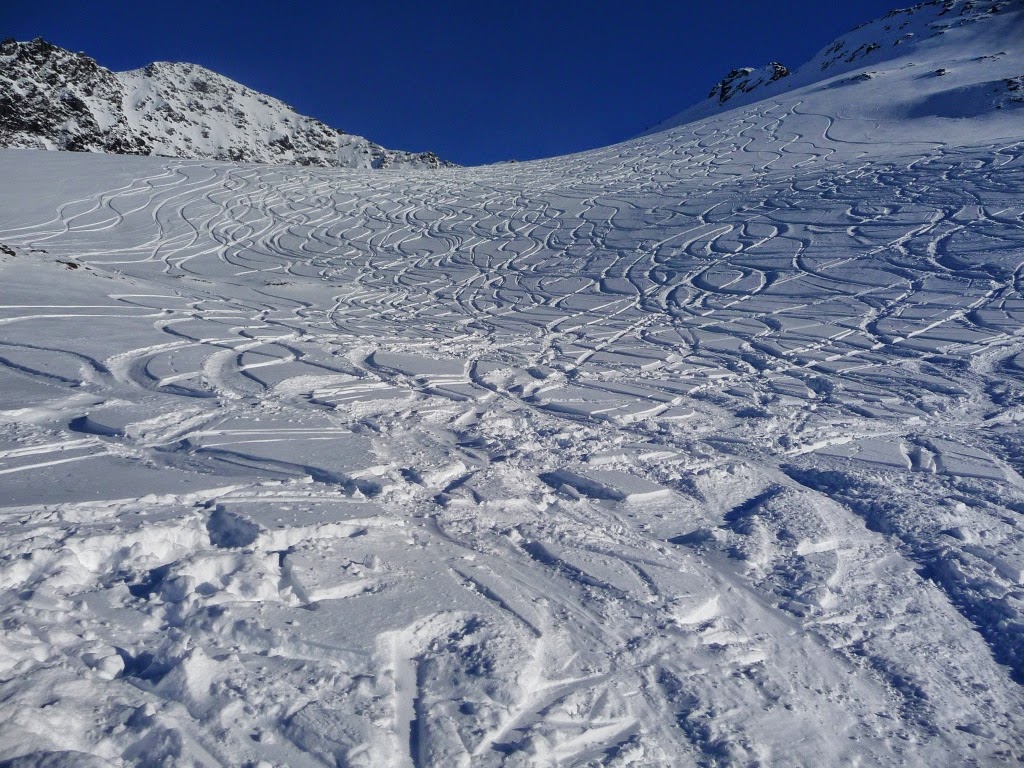
The Jewel Glacier in Crow Pass has a reputation for getting skied hard in October and early-November.
Lots of things can ruin backcountry skiing: wind, rain, no snow, warmth, other users, other user groups, limited access, a hard night of partying – just to name a few.
In the context of this conversation, ruined refers to the more controllable human factor, it refers to the number of people skiing an aspect, an area, a zone, or in general: “the quickness that said geographic feature or region gets ‘tracked out’” – another subjective concept.
It also extends to the feeling of whether the backcountry truly is the backcountry, or just an extension of a public park or ski resort.
If we define ruined under any of these contexts, than I would say that, in short, yes, the Internet is ruining the backcountry.
Hurrah! Down with the blog, the Facebook, the Instagram (let’s get rid of Twitter, cellphones, fiber optic cable, satellites, and ah hell, fire too [damn smoke signals have been giving away the goods for millennia!])
In long: the Internet is ruining the backcountry, only in the way that individually, rain, wind, or warmth ruins skiing after a mid-winter rainy, windy, and warm storm.
If you slept through English, this is called a “metaphor,” and the Internet is like one piece of that crappy storm.
The storm, as it is, is mammoth: it’s the explosive growth in the popularity of backcountry skiing, both in Alaska and the Lower 48.
Also to blame in this storm are:
The ski manufacture industry.
The ski clothing manufacture industry.
Ski-related publications and video productions that have glamorized the backcountry.
This storm has been complex, and not unlike a powerful extra-tropical system unleashed upon an Alaska mountain range, its impacts could appear both positive or negative, depending upon the lenses from which they’re viewed.
A lot of good has come from this storm.
Arguably, while the backcountry may feel more like the front country on some days, help is far closer than it has ever been before in the event of an accident; I think that knowledge on avalanche safety among backcountry skiers is greatly improved; snowpack monitoring is way up; access rights are potentially better protected by a greater number of users; and while gear is still spendy, the economy of the industry is theoretically healthy and strong, promoting growth of ever more safe and capable equipment.
The negatives can be highlighted by no shortage of Internet ranters and angry skiers in a crowded pullout on a sunny February morning.
In my opinion, if any one single element is to blame above all the others for the growth in the popularity of backcountry skiing, it’s last component: gear.
It’s lightweight, efficient gear that lets skiers and riders from a much wider spectrum of skill levels get out of the lift line and onto the skin track.
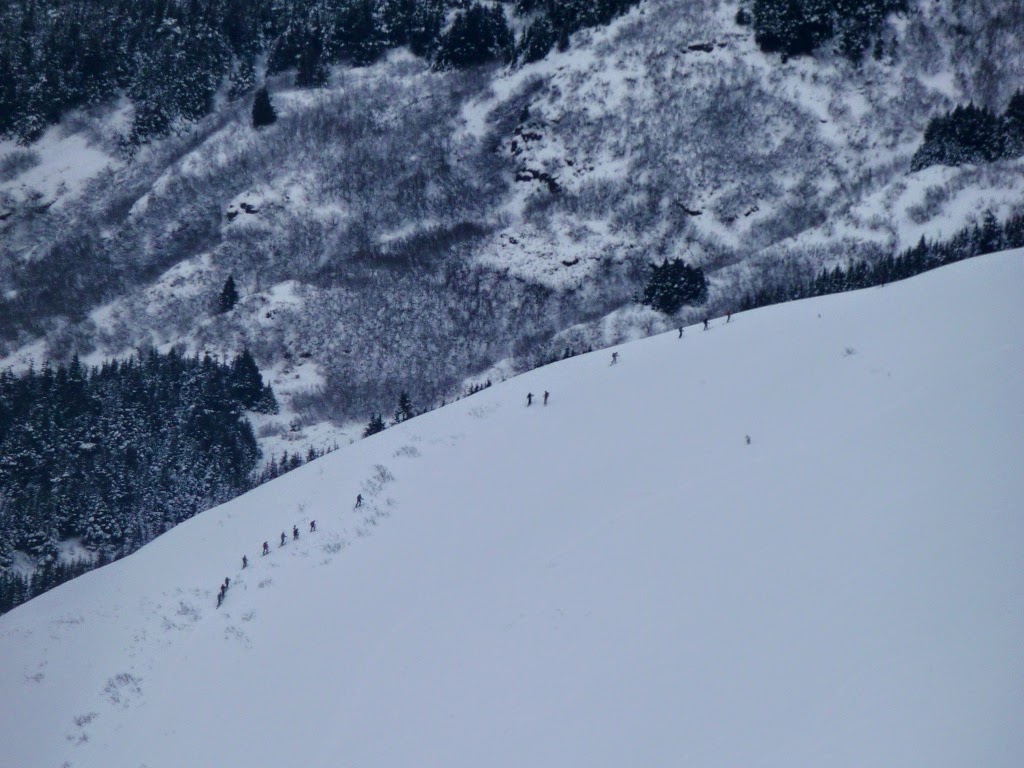
A line of skiers makes their way up Sunburst in December.
There was a time when backcountry skiing meant more work, more exposure to the elements, more suffering, and all of it was done on gear that paled in comparison to what we use today, both on the way up and the way down.
It’s not to say that backcountry skiing has become a total walk in the park, we are after all still hiking up the damn hills to get the goods instead of riding a chairlift, but when I ski with some of my wiser friends who were doing this over three decades ago, well, I bet it’s been a while since anyone has scraped pine tar off their bases at the top of a run in Turnagain.
So, as such, in those days, they often skied what are now popular locales completely alone.
That perhaps explains one component of the so-called storm, but how about the Internet factor?
I’ll back up for a second, as some background on my point-of-view seems relevant.
I started “backcountry” skiing with my friends when I was maybe 13.
We didn’t call it backcountry because we didn’t know there was such a thing. We were just tired of skiing the same dozen runs at the local ski hill, getting chased out of the closed areas by ski patrol, and didn’t have cars or driver’s licenses to go to the bigger hills. We did the only thing practical: hiked up into the Green Mountain National Forest in our backyard and made our own runs.
I learned later on that people actually did this as a sport, and even made a point of not riding lifts.
The Northeast has a few well-known backcountry locales, the comparative Tin Cans, but in central Vermont where I grew up, if you knew of a good hardwood glade that boasted 1,000 feet of vertical, you kept your trap shut if you knew what was good for you. Forget catching heat on some Internet forum, spilling the beans would have been worse than backstabbing your best friend.
Indeed, if someone was stupid enough to go out and post GPS coordinates of all the local stashes – both inbounds and out – that can be found in the Northeast, it would take an Internet second before someone would offer some choice words and/or a death threat.

One of my favorite stashes growing up, seen in December 2012. Still not saying where.
A similar reaction can, and has been provoked for bloggers and forum posters here in Alaska too – though I can’t say I have ever been the direct target.
It obviously cracks me up.
I admit, there are a few areas in road-accessible Alaska that are worth keeping “quiet” about. There are some nice areas that are even nicer not to share or blab about. I wouldn’t call these places secrets though.
Realistically, backcountry skiing in road-accessible AK is limited only by one’s own physical abilities and their imagination.
You can see, plan, and execute a great number of lines from the comfort of your still-running car. A near-infinite number of others are executable with a topographic map and some limited base knowledge.
The idea that there are secrets in these mountains, or that they are being spilled like BBs from a jug by the keyboards of Internet bloggers and forum posters, is right up there with tin foil hat conspiracies (there are a lot of folks up here who wear tin foil hats, and as such, plenty of rage).
The truth is, that while someone could find motivation or reason to ski somewhere simply because of an Internet post or picture, they could find an equal amount of inspiration because they can see a skin track leading to the same peak.
That’s the thrust of my comparison here with where I grew up and AK: you can’t spot sweet hardwood glades unless maybe you’re a trained forester, and even then, where’s your vantage point, on a road surrounded by trees? A lot of finding good spots to ski in Vermont was either inside info, or having the curiosity to go explore and get shut out.
Here in the AK, backcountry skiers have used the inter-webz in an ever increasing amount to stay on top of weather and conditions in the nearby ranges through a suite of resources, including posts by others. I myself have absolutely used other’s posts to plan and execute descents, but that’s not to say that I wouldn’t have done them without those resources either.
I’ve also gone and checked places out simply because there was a skintrack there.
Just as anyone who has ever chased a worthless skintrack can tell you though, the truth is, blogs can, if anything, be fairly unhelpful, depending on what the blogger choses to include.
A few rad pics might make me want to check out a peak or an area, but odds are, I will rely on my own experiences, interpretations of conditions, and first-hand information, before I will charge off will-nill with powder fever because some picture gave me powder fever.
In my own blog, I tend to play a balancing act. If skiing something that is directly visible from the road, ya, there is no ambiguity: this is where I was, and this is how it skied. For more worthy objectives, I may actually choose to throw in a fair amount of detail. My thinking is, if it’s was a long approach or felt like a challenge, it probably will be for others as well. If you’ve got the motivation to skin for over 4 hours, endure mandatory booting, or deal with a heinous exit, just to nab a line, you’re no slouch. Additionally, if I see issues (a false summit ridge, a route that goes through a high-hazard area, a zone known for past incidents, etc) I’d feel guilty not calling them out.
Sometimes I land somewhere in between the two.
There really is no way to say if this approach is right or wrong, it’s too subjective. There will be some who would argue just posting a pic is equivalent to offering a detailed route description and topo map with a giant “GO HERE” label. Others might find the same info insufficient or unhelpful.
In the end, I land in the same place. The backcountry is definitely a busier place, even in my own 7 short winters here. I don’t even think skiing within 1-mile of the Seward Highway in Turnagain Pass or Hatcher Pass road qualifies as backcountry skiing anymore, at least, any more than skate skiing in the Anchorage Hillside. Good or bad, it is what it is.
That being said, I’ve skied on days where these same zones had parking lots that were filled to capacity, and I’ve still gone the bulk of the day without encountering a single other individual. The fact is, we live in a place with a lot of country, and it takes a surprisingly short skin to leave it all behind.

Sunday, November 16, 2014

It Never Starts Like It Should

But this one. Wow.
It's felt like the past two falls have been particularly ornery. Cold, dry, snow-less.
I think most people I know would take either in a heartbeat.
It could all change in a breeze, but it's hard to imagine it will.

Hopeful that snow was falling up high, and eager to be in the mountains, Phil and I headed up to Jewel Glacier on Friday to investigate.
Snow may have fallen, but Mr. Weend was out with his buffer, making sure the mountains stayed smooth and brown. I've seen more snow up there in September.
Jewel Glacier was several inches of supportable wind crust all the way up. It was a slippery skin, but surprisingly consistent skiing. The upshot of Mr. Weend's OCD was that despite the thin cover, we were able to make it to within a mile and a quarter of the car before it was time to go back to foot travel.


A dog chased us up the road from the Crow Creek sub-division and did the rent-boy routine in the parking lot, tagging along for the trip. I get the feeling this pup spends more time up here than anyone else and is a true mountain dog. Otherwise, we had the Pass and the glacier to ourselves.

Wind-buffed but carvable.


Spring-like snow and hot-pow where an avi had spit out some debris during the last storm.
Word was out that the riding in Palmer was dry and dusty. Cody and I headed up Saturday in rather winter-ish temps. The riding was as good as expected, and the frosty forests and fields were beautiful. The bonus was riding the newly-built trails. So much fun.


Photo courtesy C.G.


On other fronts, the slow start is good for house projects.

Tuesday, July 29, 2008

Fresh Alaska

As promised, pictures from this past weekend.

My bosses wife owns a rental cabin in Girdwood, about two hours from here or a long half hour from Anchorage, nestled at the end of the the Turnagin Arm. Girdwood is home to Aleyeska, Alaska's premier ski resort. (for the record, Alaska's premier skiing and riding is not lift serviced) After several weeks without any time off, and a vacant weekend at the rental, my boss thought it was about time I take a day for myself. On Saturday afternoon after finishing cleaning the day's catch, I, along with one of the guides, Roger (not his real name) and his wife, Annete (ditto), the camp cook, headed off.


The chalet


With plenty of snow on the upper slopes, I originally considered bringing my board and boots and getting some runs in. They would have been short however, and I already hiked Aleyeska a few weeks ago when I went to Girdwood to clean the the chalet. Instead I opted to hike Crow Pass.

The 14 trail connects two ends of the Chugach National forest, but I was content to crest the pass and take a look at Raven Glacier on the opposite side.

An early view back down the lower Crow Creek Valley


Columbines were still growing aplenty even in the trail's lower reaches.


A helicopter flew overhead on my way up, just remember that...


Below treeline variably sized patches of snow remained in areas deluged by avalanches this winter. Here a few plants emerge from the frozen ground like it's late April.


A view back down the pass as I began to hike out of the treeline


Higher up, the trail crossed large patches of snow in the gullies. There's only two ways these patterns get imprinted in them too!

Twin falls below the pass

Just below the pass is an A-frame forest service cabin. A massive snow field hat the top made me wish I'd brought a pair of skate skis. Here, the outhouse sits buried in 5 feet of snow. If La Nina keeps it up, there'll be a glacier here real soon!


Crystal Lake at the top of the pass, still partially under ice


From the top, I hiked a short ways down in to the Eagle River Valley

After dropping down a couple hundred feet I debated crossing the gully and having lunch next to the glacier or going up for a better view. Roaring water, audible even from my vantage encouraged me to try up.

I headed up the scree field to this medieval looking protrusion
Here's the same view of my route up to the cliff from the trail. Cameras just can't do these mountains justice. I even thought it'd be a quick 20 minutes, 45 minutes of steep scrambling later, I was happy to sit down and have a little lunch.


Remember that helicopter? He came back, this time I was looking down on them. That was something else, I could even see one of the occupants point at me. Weird


Full with some of my own smoked sockeye, bagels, and cream cheese, I moved back down the slope, taking my time on the loose rock. One slip could really change the course of an afternoon in these mountains.
Not sure

On my way back the clouds lifted a bit.

Looking back


Weekly update:
Last week was our best ever for kings. We had two over 70lbs in the same day, along with three in the 60 lb range, and over a half dozen 40+. None of our clients got skunked all week. Unfortunately the red fishing slowed down big time. Daily runs calculated by the sonar readings down river never topped 15,000, and several were under 10,000. rumours abound that the river will be shut down, and already the salt has been closed. Hopefully, with the nets out of the water, we'll see a strong rebound.
The weather has been less than impressive with rain six of of seven days, most the time constantly, and a typical high of 58 or 59. Snow was reported in the Chugach outside Anchorage mid week.
Time is ticking up here, I need to spend less time fishing and blogging, mostly fishing though, and start trying to nail down a job for the fall.